
-

أصرّ / يُصِرّ على
a9arra / yu9irr 3alaa
to insist on
Form IV doubled verb -
 Will be interesting to hear the answer jenkki but when I lived in Saudi I only ever heard people use سديق...everyone seemed to use it all the time regardless if they were the janitor or managers.
 -
Well, interesting to highlight, most colloquial words are classical originally, sometimes the pronunciation could be twisted slightly, but they are still classical in origin.
Another thing, a word could be used as colloquial in country although it is considered to be just classical in another country.
Both (صاحب) and (صديق) are classical words, and the use in the street varies from a country to a country, and even from a person to another in the same country.
By the way, 9aa7ib is from 9a7iba, which is to be with someone most time, and 9adeeq is from 9idq, which is to be truthful with someone, you see the derivation!
Finally, @jenkki , (I insist) means (U9ir أصر).
Hope that clarified something everyone. -
If it is a close friend or mate, صاحب is preferred to صديق .
صاحب also means owner, possessor, holder, master.
صاحب العمل – employer
صاحب المنزل – landlord
صاحب الأملاك – proprietor
صاحب الدعوة – host
صاحب المحلّ – shop owner
صديق بالمراسلة – penpal
صديق معرفة – acquaintance
Plural of صاحب is أصحاب and of صديق is أصدقاء
-
Salaam
Ya nas ;)
I just wanted to know if anyone could help me out with these phrases and tell me if u have heard of them! like can someone tell me where in the Arab world they are common in! thanks
Ish hada? – What’s this? (Basically being said to somebody who has done something questionable
Muk mafi – no brain! (this is usually said on whisper by the person and normally he is the only one who can hear)
What does the word agulak mean?
Tsadeg 3ad – to tell you the truth
Ma3a nafsuh – with himself (if someone will do what you don’t want to see)
La ya sheikh for a male and for a female la ya shekha – said with sarcasm to show you don’t believe them
Bi aq’l tifl or fi aq’l tifl – the brain of a child
Bi ruh tifl or fi ruh tifl – the soul of a child
-
Moshaya/Ehab - sorry to bug you about this, but Moshaya you mentioned in another post that you would categorise podcasts with 'MSA' or dialect etc like you do with some labelling them 'levantine', but the last few podcasts dont have any labels on them.
It would be very helpful... -
@Zacheriya, enhancements to the website takes time. If we could add things overnight then we would. Regarding the labelling, we would have to go back to all the lessons to label them and then code the new feature into the website. We have noted this request but I can't tell you for sure when it will go live.
-
Samra24, I've heard mafi mokh used in Saudi but I'd guess it would be more Egyptian? Will be interesting to hear how others answer
-
@Zacheriya, if you post the level(s) of lessons you may be interested in, perhaps some of the people posting here can try to give you a little informal help identifying lessons. I think, roughly most of the lessons analyzing conversations at levels above beginner tend to be colloquial, but the accompanying podcast commentary also normally provides insight into the classical. Beginner lessons and lessons illustrating more formal situations (such as applying for a job) tend to be more classical. Where the lesson is colloquial, that tends to be stated early in the lesson as well.
-
I also think all of the grammar-oriented lessons (except a few very interesting ones labeled Levantine) concentrate on teaching classical.
-
شعرت هذا الدرس كان من السهل لطالب متوسط ولكن ذكرني المشكلة التي نواجه في الامارات حول استئجار المنازل و أصحاب المنازل يصرون ان المستئجرين يدفعون ايجارا سنويا و لا شهريا
Intermediate - Expired license
| January 27th, 2012 | 1 comment |
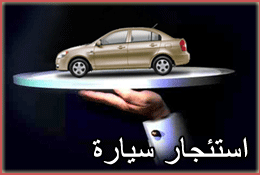
Everyone knows you need a valid license before you rent a car, so if you work in the car renting business and get a customer who thinks he can get away with an expired licenses, then you can use a lot of the phrases in today's lesson.
 |
 MP3 Download MP3 Download
 PDF Transcript PDF Transcript
|
 Audio Transcript Audio Transcript Exercise Exercise PLC PLC Dialogue Dialogue |
|
| Basic | Premium | |
|---|---|---|
Join the Discussion
Random Word
بسرعة |
|

Advertisement
BTW. I know that صاحب means companion, but I've learned that in colloquial it is used as "friend". Is it fair to say that سديق is the فصهى word and صاحب is عامية, or are they just multiple expressions used in both classic and colloquial?